I have withdrawn this editionafter uncovering important new historical evidence. More news will appear here.
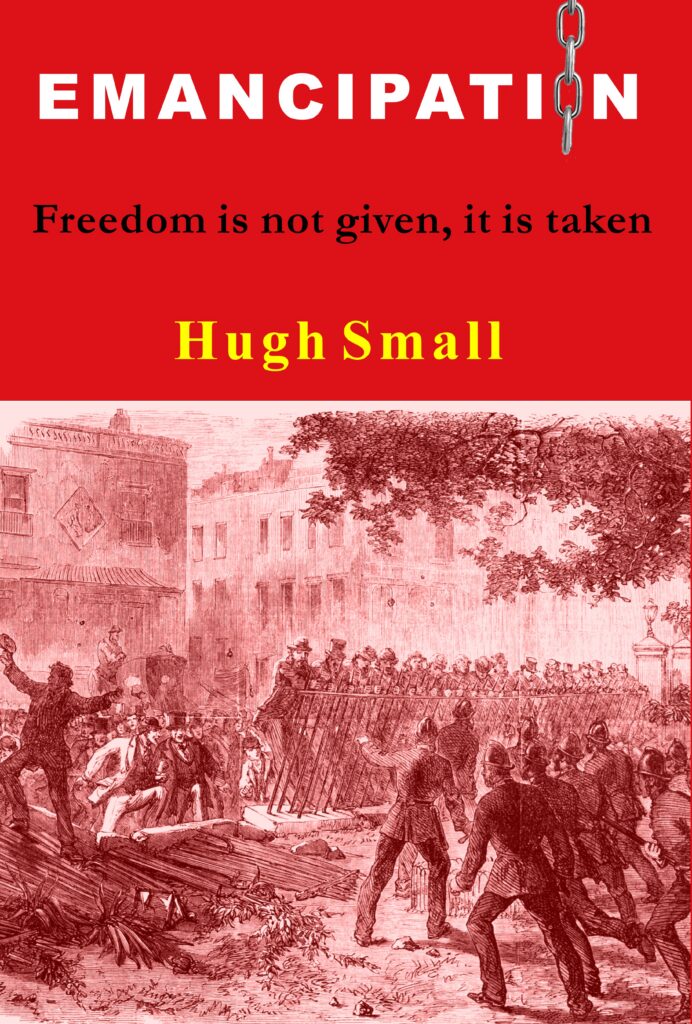
Art, like historical fiction, can be more effective than history when describing a social revolution. History overplays the role of political ‘decision makers’ who are, as Tolstoy said, only corks bobbing on the waves who believe that they are causing the human ocean to move.
Hugh Small sets his historical novel during a period of dramatic change that followed a war pitting Britain against Russia in 1854-6. The war killed hundreds of thousands of conscripts with no enduring result. Survivors and relatives of the victims knew that responsibility lay with the indifference of the ruling classes towards the fate of their impoverished subjects.
Central to the novel’s plot is an unconventional love triangle involving a disillusioned army officer, under a cloud for mutiny, and a wealthy society hostess and her husband. The story develops their intimate relationship in convincing psychological detail. Their interactions with a handful of other characters are described with equal realism. The characters include army deserters, Tsarist spies, a criminal who enlisted to escape the gallows, prostitutes, and the daughter of a Marquess who rejects her title and inheritance.
These characters are imaginary, but the forces that acted on them existed in the real population. Those forces included dramatic improvements in the technologies of transport, communication, and publishing in the most dynamic decade of the Victorian era. The novel’s characters did not cause the emancipation of the serfs or the granting of the vote to British working-class households. Nevertheless, the energy flowing between real people like them caused the movements of the human ocean that created a social revolution.
Why did Parliament give votes to working class householders in 1867?
In 1866 Parliament rejected a proposal to reduce the property qualification, which would have added 200,000 voters in England. Parliament feared that 200,000 new, poorer, voters would make government too ‘democratic’. But one year later the same Parliament passed an Act that added one million poorer voters, doubling the size of the electorate. The result was a landslide defeat of the Conservative government in the 1868 general election. The new Liberal government enacted laws that founded the welfare state.
What caused the U-turn in Parliament? Different historians with differing political perspectives offer three possible explanations for why the 1867 Act passed against all expectations:
- Rivalry between Disraeli and Gladstone to be the first to extend the franchise
- Disraeli’s social conscience as revealed in his novel Sybil, or the Two Nations
- The skill of the leaders of the popular Reform League
Any or all of these three explanations may be ‘true’, but each is limited by its reliance on the written records of eminent and charismatic leaders.
Any complete explanation would need to give weight to the social consciences of thousands of men and women who had witnessed the inhumane treatment of the working-class armies during the Crimean War.
Why did Tsar Alexander II free the serfs in 1861?
Tsar Alexander II told his Nobles in 1856:
“My intention is to abolish serfdom … you can yourself understand that the present order of owning souls cannot remain unchanged. It is better to abolish serfdom from above, than to wait for that time when it starts to abolish itself from below.”
The Tsar’s aunt Grand Duchess Elena Pavlovna is said to have convinced him of the need to take this step. But obviously things were happening in Russia ‘from below’ that are unrecorded in history.
Historians lack the detailed records to evaluate the contribution of a multitude of anonymous individuals. Fiction can bring it to life by imagining the personal development of a small sample of the relevant population. That is what Emancipation does.